
Your 30-Delta Put Is Not a 30% Chance
Most option sellers would say about 30%. Delta is the most common shortcut for picking short strikes: 16-delta strangles, 30-delta cash-secured puts, 10-delta wings on an iron condor. It is quick, every platform shows it, and for many trades it is close enough. But delta was never meant to be a probability, and on some underlyings the gap is large enough to matter for how a trade is set up and managed.
Below I compare delta with the probability that the option prices themselves imply, on four option chains from the same day: SPY, Apple, Broadcom and Bloom Energy. None of this is a backtest or a forecast. These are the odds the market priced in on 12 October 2026.
Why delta is not a probability
Delta tells you how much an option's price moves when the stock moves by one dollar. It happens to run from 0 to 1, which makes it look like a probability. In the textbook model the two are close but not equal, and they drift apart the higher the volatility and the longer the expiry. For puts, the probability ends up above delta, for calls below it. At 20% volatility and 30 days, a 30-delta put finishes in the money about 32% of the time, close enough. At 80% volatility and six months, it is 51%.
Real option chains add a second effect: the skew. Out-of-the-money puts usually trade at a higher implied volatility than calls, most of all on indexes. The skew pushes the odds the other way: puts below delta, calls above it. Which of the two effects wins depends on the underlying.
30-delta options, 32 days to expiry
Delta says 30% for every cell in this table. The option prices said this:
Underlying
30-delta put
30-delta call
SPY
22.3%
33.8%
Apple
28.4%
29.8%
Broadcom
32.1%
26.4%
Bloom Energy
36.5%
22.7%
Chance of finishing in the money, read from the prices of neighboring strikes (includes the skew). Chains from 12 October 2026, expiry 13 November 2026.
So, your guess: the 30-delta Bloom Energy put had about a 37% chance of finishing in the money. With three months to run it was 43%, with five months 48%. On SPY, the same delta stood for a 22% chance. Same delta, very different odds, read off the same day's prices.
Many platforms show a “probability ITM” next to delta. It usually plugs each strike's own volatility into the textbook formula, as if that volatility applied to every strike. That misses most of the skew's effect. On SPY it would have shown about 31% for that 30-delta put, while the option prices implied 22%.
Short Strangles: same delta, different odds on each side
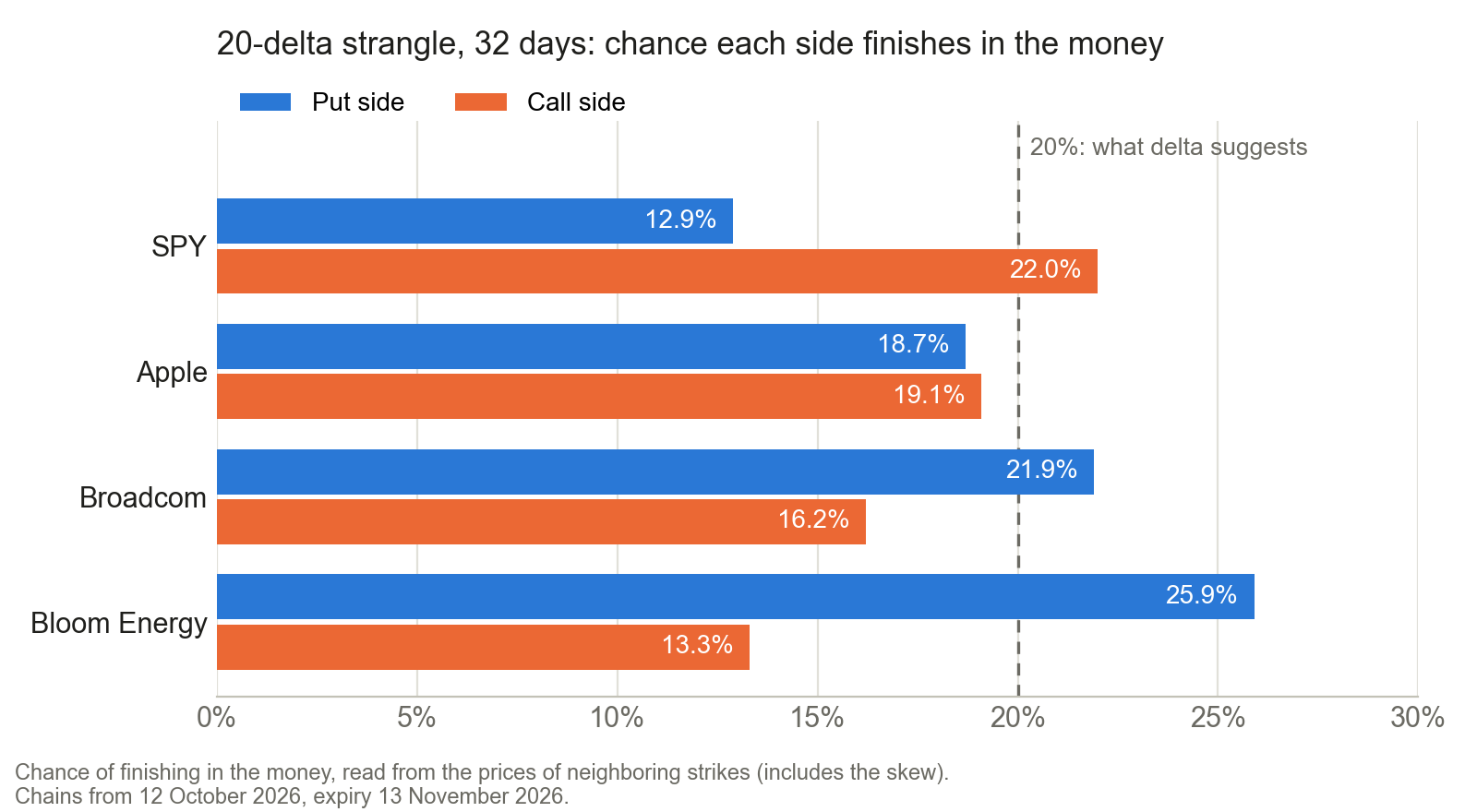
A 20-delta short strangle is often described as a 60% trade: each side has a 20% chance of finishing in the money, which leaves a 60% chance that both sides expire worthless. In these four chains, the total held up fairly well, with a 61% to 65% chance that both sides expire worthless. The split between the two sides did not.
SPY: the put side had a 12.9% chance of finishing in the money, the call side 22.0%. On the index, the call is the side more likely to end up in the money. Bloom Energy: the other way round, 25.9% on the put side and 13.3% on the call side.
So a strangle with equal deltas is not a strangle with equal odds. On index strangles, the call side finishes in the money more often than its delta suggests. On volatile single stocks with a flat skew, it is the put side. If you want the same odds on both sides, the strikes have to be set by probability, not by delta.
The wheel: assignment and called away
The wheel runs on two deltas: the put you sell until you get assigned, then the covered call you sell until the shares get called away.
SPY: a 30-delta put had a 22% chance of assignment, a 30-delta covered call a 34% chance of the shares being called away. Fewer assignments and more call-aways than delta suggests. Bloom Energy: 37% and 23%. More assignments and fewer call-aways.
On an index ETF, a 30-delta covered call caps the upside more often than “30%” suggests. On a volatile stock, a 30-delta put puts the shares in your account more often, and the longer the expiry, the larger that gap.
Rules of thumb
Short expiry, moderate volatility, moderate skew: delta is a decent shortcut. Apple was close to delta. Index ETFs with a steep skew: delta overstates the chance of a put finishing in the money and understates it for a call. Volatile stocks with a flat skew, and longer expiries: delta understates it for puts and overstates it for calls.
One more thing: touched is not finished
All of these numbers describe where the option finishes, not what happens on the way. A strike gets touched about twice as often as it finishes beyond it, which I measured on 469 stocks and the S&P 500 in a separate probability of touch study. For managing short options that has a practical side: on average, about half of the strikes that were touched still expired out of the money. The exception is earnings. A strike touched on the earnings reaction day finished in the money about six times in ten, because the gap had already carried the price past it.
Data and notes
Option chains for SPY, AAPL, AVGO and BE, downloaded on 12 October 2026 during US trading hours. Expiry 13 November 2026 (32 days), plus 15 January 2027 and 19 March 2027 for the longer-dated figures.
The implied probabilities come from how option prices change from one strike to the next. They matched the raw prices of neighboring strikes typically within about 1 percentage point, on Bloom Energy within about 2.5 points because of its wider bid-ask spreads.
All probabilities are risk-neutral: they describe what option prices imply, including the market's price for risk. They are not forecasts and not trading advice.
The full tables for all four underlyings, deltas from 0.10 to 0.50 and three expiries are in the original study.
About the author. Nikolai Alexander has a background in business, econometrics and biotech and has analyzed financial markets for more than ten years. Today he advises on data analytics and teaches statistical methods up to PhD level. He also builds analytics tools for option traders at https://nikolai-alexander.com/OptionsCone/.